Last year, in a post, I processed some autosomal and Y DNA points of interest in my wife’s family. A total lack of thruline ancestor matches with her paternal surname family, strong matches with more distant cousins on a maternal branch of that family, and previous Y DNA testing on her paternal line made me wonder about intra-family adoptions and non-paternal events.
The long story short is that my spouse and her brother seemed genetically overrelated to a great-grandmother whose family came to the U.S. from Sweden and Norway, and not at all related to a great-grandfather whose family has been in the U.S. for 300 years. That and Y DNA matches to a small group of Swedes had me following up on Y DNA from great-grandmother’s family to see if my wife’s dad and grandfather were Mills/Svenssons rather than Sutherlands.
What’s in a Name?
I’m going to use these names a lot Mills, Svensson, and maybe even Svensen or Svendsen. Here’s what you need to know, Nordic surnames weren’t standardized until really recently. In Sweden this happened in 1901. So it’s not like English families that standardized hundreds of years ago.
So for example, in 1850’s Sweden, I would be Mike Thomasson, and my father would be Thomas Karlsson, and his father would be Karl Raimundersson. So we’ve got that going on, but my wife’s family also moved between Sweden and Norway, and so their Svenssons became Svendsens and Svensens in official documents.
When they got off the boat here, it probably would have standardized to Svensen or Svenson, but a lot of immigrant families picked English style names for their new life here, and it’s not like their previous surnames were very identifying for them, they changed every generation. My wife’s family picked Mills.
Johan Svendsen from Sweden became John Mills, “regular American”, in 1880.
DNA Testing Completionism
If you look at that older post, you’ll see that I was lucky enough to have a willing family member provide their DNA for comparison, and I had a Y-111 match with my brother-in-law for the first time since I ordered his tests years ago. That left me with 99% certainty that we had some sort of crossover event that led to my spouse and kids having no genetic links to their Sutherland forebears.
When I talk about worrying, I have a problem: it is the problem of wanting to chase these things down when they neither put food on the table nor a roof over my head, but hobbies are hobbies. It could have been model trains, but eh..here we are.
This year, completionism kicked in, and I decided to upgrade that Y test to Big Y to confirm the match. Today, I got the initial results back, and they are only a few Big Y SNPs apart. The two of them should now form their own documented Y DNA branch under I-BY389.
Their last common ancestor with other matches is around 200 CE, so this new shared branch of SNPs will be a huge time jump to 1849 CE for their new last common male line ancestor Johan Mills. Right now, I don’t know what FTDNA will name this 1600-year-long Y DNA branch. I’m assuming they will pick one SNP to represent the line.
Relationships
Here is the family tree between my wife and her Mills cousin. As far as Y DNA is concerned, Ronald Sutherland is effectively Ronald Mills. Since Katherine Mills has no other children, I don’t have anyone to check against to say how closely related Ronald was to his mother Katherine.
What I’m saying there is that I can’t tell whether Katherine was actually Ron’s mother or his sister. She has no other children to compare with. I do know that Ron is a male line Mills.

The other thing that I noticed, outside of there being no Sutherland side relatives through Ron, is that the Mills matches seemed large. Not monstrous, but like my wife was maybe one generation closer than she expected to be. Here is an example:

It’s not that those 2nd cousin 1x removed and 3rd cousin matches couldn’t be that large, it’s just that they are at the top end of matches at that distance. They seem large to me.
I would have said that we are just seeing an NPE on the Sutherland side of her family with Ron Sutherland, except that no other family is mysteriously showing up in her matches to replace the Sutherlands genetically. He’s just a Mills, related to his grandparents, John Mills and Lula Yates, and that seems to be it.
Speculation

Lula Yates, Ron’s grandmother, John Mills’ wife, is 43 when she has her last son Robert in 1925. She had a child every few years since she was 24 years old. Without any information about relatedness to Katherine and with no other family filling a gap, it seems possible that Lula is Ron’s mother and that Ron was adopted by Embly Sutherland and Katherine because Embly and Katherine were unable to have children. That’s my best guess given what I have.
It’s also possible I’m just missing some other family. It seems less likely to me right now, but Ron could be the son of one of Katherine’s brothers, then adopted by Katherine. That’s not uncommon. I just don’t have a family yet to fill in that gap of who would be Ron’s biological mother.
Intra-family adoptions have happened in my own close family, with my male line Thompson cousins being adopted by our aunt Cheryl Clark. A few generations from now, the Clark children and grandchildren might have a small genetic mystery to uncover.
It’s also possible, without any evidence, that Ron’s tree goes straight up and he’s double related to the Mills family as a product of two siblings or a lopsided pairing with a parent and child.
Without testing Ron, I’m not sure how to see if his parents were related or how closely they were related. Testing Ron we’d look for matching segments on both sides of his chromosomes (from both mother and father), but a generation later, I think that direct comparison is gone.
Right now, that lopsided parent-and-child pairing seems unlikely to me because I don’t have any reason to think that Ron was more related to the Yates than to the Mills, or more related to the Mills than to the Yates. My wife’s matches within the Mills/Yates couple’s descendants seem large on balance, but again, I can’t say that she looks more related to Mills or Yates. That could be a lack of skill on my part or the lack of Yates matches one generation farther back.
She has many matches descended from Lula Yates, but only one descended from Lula’s parents, and that one looks normal. Meanwhile, she has many Mills relatives that are not descended from John, and those all seem normal, too.
At the moment, I wouldn’t be able to tell Ron from any of John Mills and Lula Yates other children.
So Now What?
I like to present genetically accurate trees on Ancestry if I can. I think it makes it easier for people to make sense of their DNA matches if they can put my family in context. Where the paper trail diverges from the genetic trail, I do my best to mark that out too. Ancestry makes it easier now, with multiple relationship types.
The most accurate thing I could present is that Ron seems to be his mother’s sibling. Human nature leads us to look for the most dramatic reason because keeping it in the family, like the Habsburgs, makes for a better story. I just don’t have a better story.
Right now, my temptation is to show Ron Sutherland as a biological son of John Mills and Lula Yates, with Embly Sutherland and Katherine Mills as adoptive parents and the official parents in the tree. It’s a total best guess, but it would make sense genetically for other people who have less information and are trying to map out matches with my wife.
Without Fear
I’ve always said that Sutherland was named Sutherland because it was south of Norway. The Jarls of Orkney, who ruled Sutherland, were under the Norwegian crown. You’d expect to find some Norse-leaning Y DNA groups there. My wife’s family fit that expectation for me, and so I took a long time to look at their Y results and Autosomal DNA results any deeper.
Sutherland is a place and a clan. Scottish clans certainly contain related families, but they also include unrelated families. A clan is a group you belong to. In the past it may have been assigned or chosen based on allegiance and alliances. There are shared experiences in the memories of clans. In the modern age, it’s a thing you can be born into. but also a thing you join.
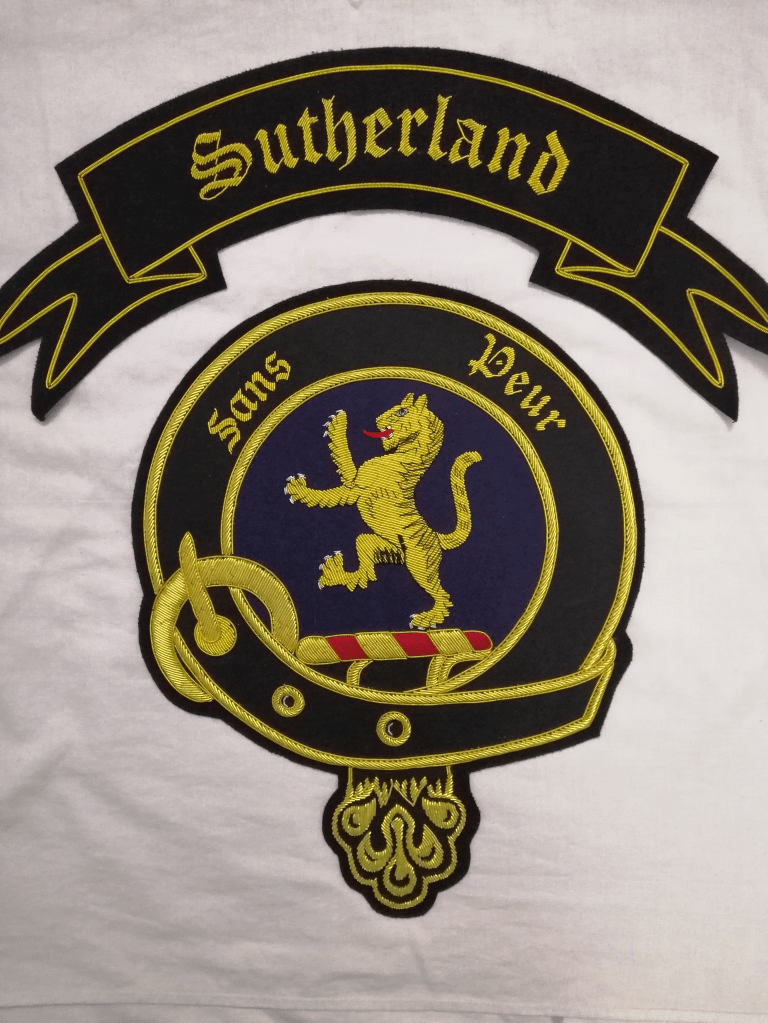
The clan motto is “Without Fear”. I always thought that was pretty damn cool. There’s no way we’ll be giving that up.
My family is new to the area where we live, but my wife’s family, the Sutherlands and Mills, Crawfords and Bronsons, are part of the local fabric. They’re embedded in the landscape as founders of several towns and cities. There are shared memories here and allegiances and alliances that permeate the history of our home. This is also a place with clans you belong to and can join.