
Old Norse Specialist Jackson Crawford
I’ve listened to a lot of Jackson Crawford videos over the past several years. If you’re interested in the sagas and the eddas, or the differences between old Norse and other Germanic languages, you should check him out. He has a lot of different content. For Halloween, this video of him talking about the undead popped up in my feed. The most striking thing for me was the idea of now and not now and how the nearly dead or just dead, are treated. It struck a chord.
I’ll explain but first here is the content for reference. If you want the whole story with all the nuance and information, have a listen: https://www.youtube.com/watch?v=DA5lQ49VcAs

The Undead
Dr. Crawford, roughly half way in, breaks down a sort of, ancient sense of time, with examples from English and other Germanic languages. Instead of past, present and future. They/we have present and not present. Not present is broken up into past and future. Present is real and true and not present is part of a dream state. Not completely untrue necessarily but also not real like the present.
How he presents that in language is to have someone say something that is untrue in the present moment. So on a sunny day, your friend says it is raining and you might say “if it were raining, we would be wet”. You’re talking about now, but because it is untrue the words you use are in the past tense; “if it were” or “if it was”.
Living people are in the now, but dying people, or mostly dead people (thanks Princess Bride), are in the not now, and you can ask them questions about it. If they are all dead, they can be awoken (not raised) and questioned about the things they know in the not now. You wake the dead to get access to both the past and the future at the same time. The undead are not quite alive, but still active and accessible. You just want to keep them from walking around.
Un-Now
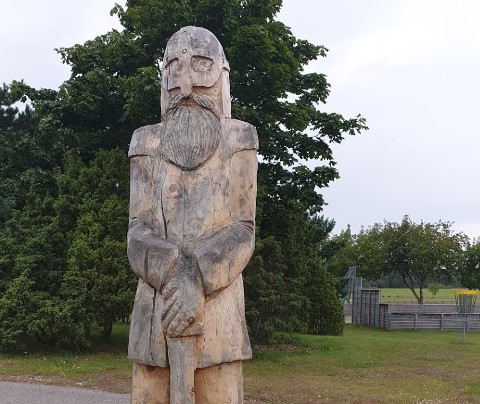
At one point Dr. Crawford breaks down the root of Draugr. A Draugr is a revenant or a ghost. In the sagas ghosts are pretty solid. They aren’t whispy spirits, but definitely have bodies. They’re somewhere between a classic ghost and a zombie. Dr. Crawford notes that draugr and dream have the same indo-european root. They are related words. You have a corporeal body, alive or unalive, in the dream state.
I remember reading one of the sagas and a guy dies and is buried but then appears, unburied, and talks to his family at night. It’s so frightening and irritating that his family reburies him elsewhere. It gave me the impression that a draugr was kind of a pain in the ass that made it hard to sleep.
The sagas always read that way to me. These things were just possible things that happen like anything else. If a person is a werewolf, it’s just stated as another fact. Like they had dark hair, brown eyes, balding, werewolf, one leg shorter than the other, tall…
So a draugr is presented as another, possibly irritating state of being that is a hassle for your loved ones. A problem to be dealt with, like a leaky roof.
I’ve Seen this Before
As I was watching the video, I realized that I’ve seen this before. I think a lot of us have.
When my grandmother was actively dying, she would tell us who had visited her. People long dead, entire groups like her church choir, and people who were physically there in the facility, freely mingled in her day-to-day. At one point, she was talking to my dad, myself and my son and she alluded to me as my dad, to my dad as my dad, and to my son as me. It bothered her not at all that my dad was physically there in the same room twice, represented at different times in his life.
I called it, “time traveling” or “fluid reality” as she was breaking the walls of space and time at the end of her life. I think she had a good trip. It wasn’t terrifying. She wasn’t panicked. These things were just happening. As they do.
If I was a Norse person, without any context for end of life dementia, how would I understand these interactions? When someone is peeking into the Not-Now right before they die?
If I had asked my grandmother a bunch of questions, would I have gotten words about the future and past from a person who was clearly hopping timestreams right in front of me?
Are the Norse, in some way, describing the unfettered mind at end of life and assuming it could continue after death?
