
These are my quick notes and thoughts on R-Z18 Y DNA in the Wang et al. study “Ancient DNA reveals reproductive barrier despite shared Avar-period culture“
Some Back Story and Context
For reference, we’ve talked about the Avars before with an R-DF95/CTS12023 Y DNA cousin in the mix with the early Avars (who are northeast Asians) that moved into modern-day Hungary. My suspicion with our early Avar cousin was that he was a left-over Gepid. The Gepid back story is that they are a type of “late or slow” Goth. They leave southern Scandinavia and settle in the southern Baltic in the 1st century arriving after the Goths, and then chug on south like the Goths, eventually settling in the Carpathian basin. They join the Huns, then turn on the Huns, fight with the Goths, fight with the Lombards, and eventually lose their kingdom. They’re conquered by the Lombards in 567.

I can’t talk about the Lombards without mentioning Szolad 4 (SZ4) the Scandinavian R-Z18 man who was also a Lombard (or living with Lombards) in Hungary in the mid 500s AD. That trek from Scandinavia to Szolad, Hungary, happened in his lifetime.

Scania (Sweden/Denmark) to Pannonia (Hungary)
and Italy

The story goes that the Gepids followed the Goths from Scandinavia south to the Baltic coast and then southeast. The Lombards leave Scandinavia, head south, and then move east into the same general area as the Gepids. The Lombards eventually conquer the remnants of the Gepids and the Avars come in from the Northeast and take over the place.
This map is in time and space. Tiszapuspoki is the early Avar grave with our CTS12023 cousin in the mid to late 500s AD. Szolad is marking the Lombards with our R-Z18 cousin in the late 500s. They’re roughly contemporary. Modling (red marker) in Austria is the area for R-Z18 Avars in the Wang study who lived around 600 to 700 AD. These Avars are living..maybe 100 years later than Szolad and Tiszapuspoki. Also in this mix are the Slavs.

When I’m talking about R-Z18 men or R-DF95 men in a location, you can pretty much bet money that there are other R-U106 men with them. For a more complete picture, in easy spreadsheet form, see the U106 ancient DNA spreadsheet that Ray Wing maintains.
Avars
Below is a map of Europe around 650 AD, about a hundred years after our R-Z18 samples in Hungary. The Gepids as an organization have been gone for a while and the Lombards have settled in Italy.

This study (Wang et al. “Ancient DNA reveals reproductive barrier despite shared Avar-period culture“) focuses on remains from a few different Avar cemeteries and compares and contrasts the genetic evidence versus the cultural evidence between geographically close communities. In previous posts I’ve talked about the sort of homogenizing factor between the locals and recently migrated people. In the Anglo Saxon cemeteries people with nearly complete Romano British ancestry are buried with the same high status items as “Invading” Saxons. Genetic analysis shows a pretty high degree of mixing. As generations progress the admixture becomes more widespread and everyone becomes more genetically similar.
This study stands out because generally expected mixing doesn’t seem to happen genetically, even though it does happen culturally. I would characterize it as Germanic, East Asian, and Pontic Steppe groups that had previously admixed seem to stop and instead pull their mates from more genetically related communities, even though they may be farther away (in the case of the East Asian group).
The locations are Modling, Csokorgasse, and Leobersdorf, Austria. Our R-Z18 men (4 samples) are in Modling. Leobersdorf is dominated by Haplogroup C2b men of east Asian descent.
Based on grave goods and cultural items, they are the same culture, but they’ve drawn some kind of genetic barrier.

Genetic Rift
That’s not to say that Northern Europeans were dominant in Modling (MGS), on the contrary it appears they are minor players in the genetic lottery with a large component of autosomal ancestry possibly associated with the Slavs.
The authors state: “By contrast, individuals of northern European ancestry, prominent in the Carpathian Basin in the fifth to sixth century ce28, and groups from the Eurasian steppes had minor roles in the Mödling ancestry
The north-eastern European ancestry had largely been absent from the Carpathian and Vienna Basins in the previous period (fifth to sixth century ce), and can be observed for the first time on a large scale at MGS in the seventh to eighth century ce.
It is probably connected to what contemporaries since the mid-sixth century ce perceived as an influx of Slavs.” (Wang et al. 2025)
While Modling (MGS) was mainly an admixture of Europeans, Leobersdorf (LEO) maintained a high percentage of East Asian ancestry. Culturally though, they’re the same.
According to the study: “The detected admixture of East Asian and European ancestry in Leobersdorf was sex biased with the East Asian component carried more through male individuals. By contrast, the introgression of north-eastern European ancestry into the Mödling population is consistent with transmission by both sexes
The genetic barrier between neighbouring LEO and MGS does not correspond to strong differences in the archaeological record. Both cemeteries are part of a shared culture of the Avar realm in the eighth century ce
A good part of the MGS population may have had similar ancestry as Slavic groups, but they shared Avar, not contemporary Slavic cultural habitus40.
to our knowledge, LEO and MGS is a not-yet documented case of fundamental genetic differences between two entire sites with overwhelmingly common cultural traits. The genetic discrepancy cannot be explained by differences in the social status or function of the sites.” (Wang et al. 2025)
The study also discusses a generally sedentary male population with a more variable and mobile female population. Even though Modling (MGS) is a mix of European Y DNA it maintains patrilocality just like Leobersdorf (LEO).
“We infer that consanguinity (inbreeding) was strictly avoided in both MGS and LEO across six generations (Supplementary Table 6). That was mainly achieved by exogamy: 17 of the 19 (90%) mothers buried in Leobersdorf with identifiable offspring have no ancestors buried on site; in the much larger community of Mödling, they are 46 out of 59 (78%). Many daughters seem to have left to be married elsewhere
The uniparentally inherited markers show a similar picture: 62 out of 77 male individuals in LEO derive from Y haplogroup C2b, which is prevalent in East Asia (Extended Data Fig. 7 and Supplementary Table 1). By contrast, female individuals in the Leobersdorf pedigree have diverse mitochondrial DNA (mtDNA) (Extended Data Fig. 7). Mödling is different because male individuals also display several Y haplogroup lineages—for example, frequent European types R1a and R1b (Supplementary Table 1 and Extended Data
This means that patrilocality and patrilineality were dominant at both sites, if to a different extent (patrilineages account for 88% at LEO and 70% at MGS)” (Wang et al. 2025)
People in Modling and Leobersdorf were both concerned about inbreeding, women seem to be married to brothers or sons if their first mate dies, both women and men have multiple relationships that bear children in both locations, showing that they are purposefully mixing it up, but Leobersdorf at some point is reaching back to Hungary for mates rather than mixing in with their neighbors in Modling and Csokorgasse.
As you can see in the map below lovingly borrowed from the study Leobersdorf most often strengthens it’s ties with the heart land of the Avars while Modling trades most often with its neighbor.
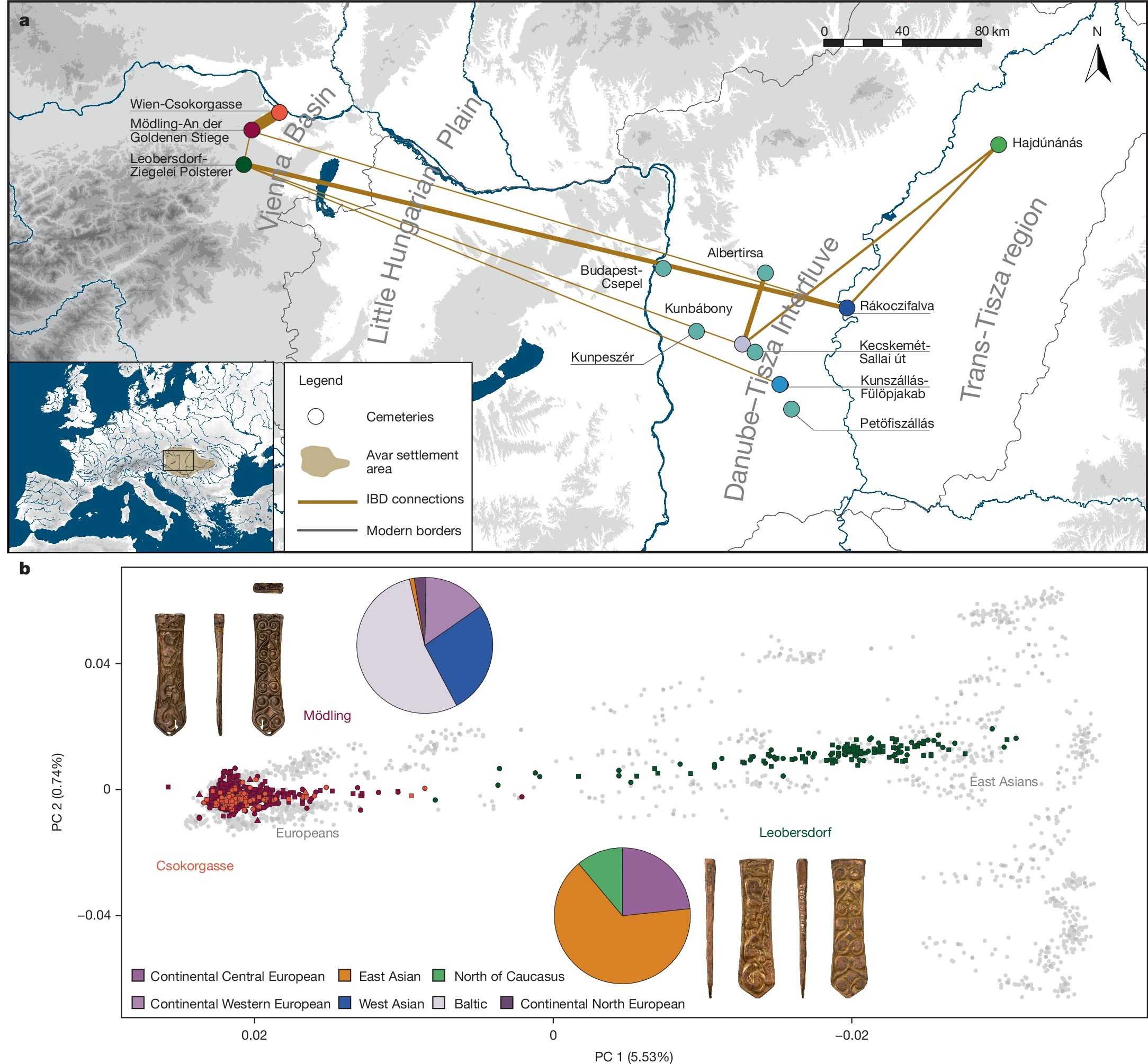
“in spite of their spatial proximity people from Mödling and Leobersdorf were only marginally mixing with each other in the course of the roughly 150 years in which both cemeteries were contemporaneously used
whereas the smaller selection of individuals from Csokorgasse shows 17 pairs of first- and second-degree relatedness (Extended Data Fig. 6) and substantial IBD connections with Mödling (Extended Data Fig. 8). LEO had more genetic connections with some sites in the DTI-Transtisza regions at a distance of almost 400 km (for example, Kunszállás)10 than with MGS
The comprehensive analysis of pedigrees and IBD networks across sites and regions revealed that this genetic barrier was maintained by deliberate reproductive strategies of the communities that despite their different genetic ancestry kept highly similar practices of patrilineality, levirate unions and female exogamy. As IBD relations show, more genetic interactions occurred between Leobersdorf and the core region of the Avar empire than with the neighbouring sites of Mödling and Csokorgasse.” (Wang et al. 2025)
The Avars in Leobersdorf were previously admixed with Europeans and shared a culture with their neighbors, yet they are going back to the Trans-Tisza for marriage. It seems odd. The authors make it seem that based on the graves you wouldn’t particularly know they are different people. The autosomal genes that give people some different appearances were not particularly pronounced in either group either. So they may not have been very dissimilar in appearance.
What have we got on those R-Z18 boys?
Well, like many of the recent studies, I haven’t seen in depth Y results for these. They stop at R-Z18, although they are certainly far below that into the branches.
The study samples are all from Modling. MGS049, MGS323, MGS325, MGS414. They do some admixture comparisons in the group, listing the most prevalent components.
MLE_6thCE is taken from the graves of pre-Avar locals in the area of Modling. Hungary Szolad south, may be some sample from the Lombard study in Szolad. Maybe a profile of the southern Europeans in the study.
- MGS049 – MLE_6thCE, Hungary_Szólád_south was roughly 60% like MLE6thCE
They also compared Modling to samples from Croatia, Turkey, and Lithuania/Baltic. The Lithuanian Baltic mix may represent that influx of Slavic ancestry the study references earlier in the paper?
“Distal modelling of the MGS site reveals complex admixture roughly datable to the early Roman Imperial Age (roughly the first century bce to the second century ce), in which predating Eastern Mediterranean ancestry (Turkey_Hellenistic/Turkey_IA) mixed with southeastern European ancestry first (Slovenia_EIA/Croatia_IA) and later with north-eastern European ancestry (Lithuanian_BA/Pohansko_9c). The small component of East Asian ancestry was added roughly 200 years before MGS, most plausibly under early Avar rule (Extended Data Fig. 1 and Supplementary Information, section 6). The north-eastern European ancestry had largely been absent from the Carpathian and Vienna Basins in the previous period (fifth to sixth century ce), and can be observed for the first time on a large scale at MGS in the seventh to eighth century ce.” (Wang et al. 2025)
- MGS323 – Croatia_EIA ,Turkey_IA, Lithuania_BA roughly 50% like Lithuania_BA
- MGS325 – Croatia_EIA, Turkey_IA, Lithuania_BA roughly 50% like Lithuania_BA
- MGS414 – Croatia_EIA, Turkey_IA, Lithuania_BA roughly 50% like Lithuania_BA
Modling has a real mix of different Y lineages, representing hundreds and thousands of years of human movement. Where did the R-Z18 men come from? Autosomally, they are the locals, with the East Asian Avars being the outside group. Given their position in modern Austria, my temptation would be to say they are leftover Lombard descendants (like my proposed leftover Gepids in the Trans-Tisza).
That could be the case, but The Slavs also absorbed various Goths, Gepids, and Huns on their migration, into the same area. I could see either or both scenarios being the case.
Some Quick Conclusions
Genetics has a lot to offer archaeology. This study shows that examining the bones and culture from grave goods is one part of the story, but there are other parts hidden in the past that are also interesting. It opens up new worlds of possibility.
Genetics is not culture. Culture is meant to be shared and spread. Sometimes genetics goes along with culture and language, and sometimes it doesn’t. Our ability to learn from and influence each other is the foundation of our survival and flourishing as a species.
There is no blood quantum necessary for culture. Culture is transient. It shifts and changes over time. Your genetics don’t determine your culture, even though they sometimes coincide.
People can mill around in one area for hundreds of years, then move half a continent away in one lifetime, and then mill around that new area for hundreds of years. Everyone is from somewhere else, yet we somehow all become the locals wherever we are.