
Every so often, I poke around at my wife’s family tree and genetic genealogy. She has the average amount of interest in genealogy that I see in my circles. Her family story is interesting enough to watch an episode here or there, but there is probably something better on another channel.
There’s no strong motive to do too much with it, but sometimes, when I’m doing something particularly interesting (to me), she’ll openly wonder if I should do that same thing with her family. You know, for the kids. There is an element of completionism.
All of this is to say that this is my hobby. If it were fly fishing, she would have about as much interest in it. She likes that I like it, and sometimes she wants to go along wherever I’m going.
When I had autosomal testing done for her and her half-brother, I picked up a bunch of family immediately, and I was jealous at how easy it was to put together. When I ran her MTDNA, a kind person jumped in and found matches in her extended family tree for that MTDNA right away. When I ran her brother’s Y-37, it came back in a major clade under Haplogroup I that favors Scandinavia. They are Sutherlands, the place is called Sutherland because it is south of Norway. The last living speaker of the Norn language was a Sutherland. It was not exactly an unexpected result and there were a few other Scots mingled in his matches.

To me, her DNA journey has been an exercise in having things line up. I was contacted by some close genetic relatives of hers who were struggling with their unknowns and their own DNA and relationship to her, but her tree was the known good in that situation.
And Then it Happened
Her brother’s sample was getting old and I’m unlikely to get another, so I made some minimum payments on my typical American debt and plunked down the cash for Big Y at Family Tree DNA. This is a long way to go for completionism, but sometimes, this stuff nags at me.
The results came back with him well down his own line, but all his Y-67and Big Y 700 matches were Swedish. It wasn’t a mix, it was six or seven Swedes. That is all. So I said…Huh.

That’s a Lot of Swedish
Then I went and reviewed autosomal origin estimates at Ancestry DNA. My wife has always scored high on Scandinavian wherever I’ve put her results. It’s an ongoing joke in the house that she is a terrifying miniature Viking.

The Scandinavian component has always stood out as high, but she does have one family line from Norway on her dad’s side, so it made some sense. Even though it was overly large.
This time, when I looked and compared, though, I noted that I’m the only one who pulls Scotland above 10% as a location. My Sutherlands are related to her Sutherlands. My wife and my dad share autosomal DNA, and I’ve always chalked it up to our mixed Sutherlands here in the U.S.
The low level of Scotch-toberfest related genetics and the high Scandinavia, particularly the high Swedish component in my wife’s Ancestry DNA results started to remind me of the high Irish component of my aunt.
With my aunt, it turned out her paternal grandmother came from Ireland, and it was the first time I took autosomal origin estimates as a major factor for research, because it was out of character for the rest of my family and such a large component of my aunt’s DNA.
Ancestry splits DNA by parent (which is awesome). Sweden is the second largest section of my wife’s origins on her father’s side. Germanic Europe is the top spot, which makes sense in her mom’s family tree but doesn’t make sense for her dad. Denmark is in the top three for her dad. None of that lines up. So I said…Huh.
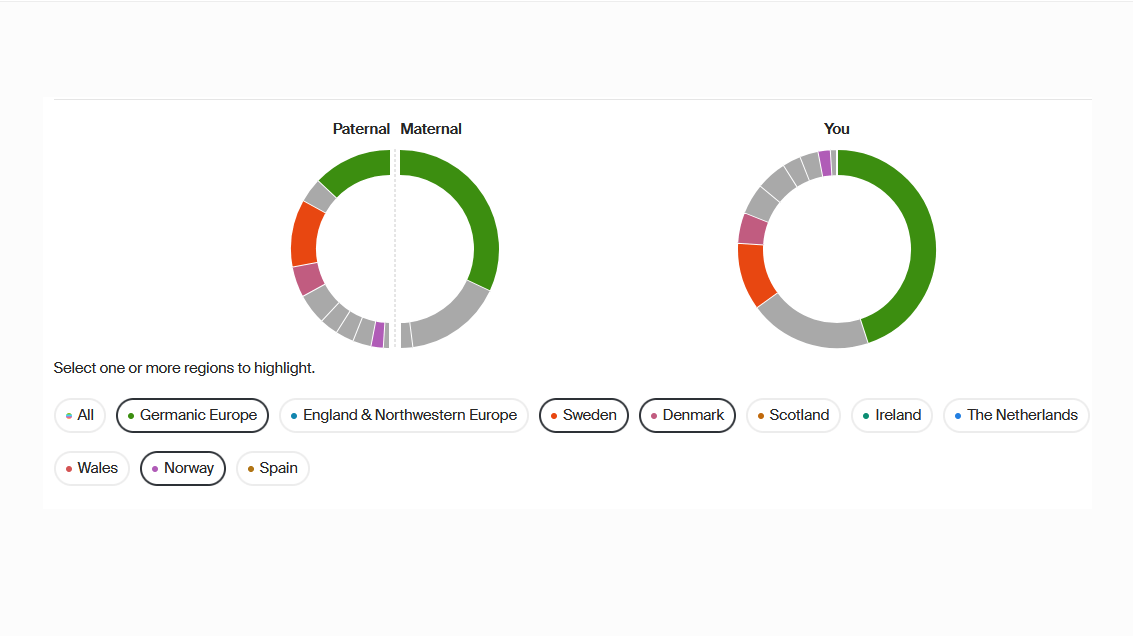
High Swedish component, no known Swedes in the family. Y DNA matches only Swedes. Norway was the major colonizer in Scotland and Ireland, I’m not sure what kind of impact Swedes had in that.
Time to Look at the Autosomal Matches
Back to Family Tree DNA, I did an “in common with” search with her brother’s matches. I picked up all kinds of relatives that fit nicely with their shared Southern U.S. heritage through their paternal grandmother, but the largest match there was a U.S. DNA relative related to their Norwegian family, the Mills. A few generations back, in the 1880s, the Mills family immigrated from Norway.

Mills is the name they picked when they came here. Their name at immigration time was Svenson or Svendsen. This is at the time when surnames changed every generation. So my wife’s third great-grandfather, John Mills, was Johann Svendsen, and his wife was Oliva Torgersdottr. Oliva’s father was Torger Andersen..etc. Spellings vary based on the record, but you get the idea, surnames only lasted a generation anyway, so they were only meant to differentiate people in a small community.
It’s the same process that generates a Thomasson. At some point in England, Thomson and Thompson formalized and became multi-generational. Enough generations pass that we have no idea who the original Thomas was in any particular family.
Back at Ancestry DNA, I run through my wife and her brother’s autosomal paternal shared matches and see their shared Mills family from their paternal grandfather, along with Many Southern relatives that line up with their paternal grandmother. I have them color-coded (ancestry lets you do color-coded labels)
I’ve Been Here Before
Where are all the Sutherlands? Where is their paternal great grandfather in their results? I can’t find any. Not any, anywhere. Not even small matches that go way back.
I say I’ve been here before but really this is like a different road to the same county. With my own “Where is my Great Grandfather Thompson hunt”, the Thompsons were missing and there was definitely another family bubbling up in there to take their place. I had all these pieces that just didn’t make sense without the context of the Elmores.
With my aunt, I had missing Thompsons, and another completely different family bubbling up with overly large genetic contributions from this strange missing Quebec and Ireland related family. It wasn’t coming from my Grandfather and it all seemed a little too big. The matches were from the 1800s in the family trees of genetic relatives, but much larger than other matches at the same level. Why?
As it turned out my aunt is one generation older, on her paternal side. Her biological father was the same age as her mother’s father. She was literally one generation older on her paternal side. Her father was born in the late 1800s, not the mid 1920’s.
Going back to my wife, what I had put in my notes repeatedly, sort of without realizing it, was that her Mills matches were overly large. In her matches, there is a missing Sutherland family, like my missing Thompsons, but unlike the missing Thompsons, no other family was bubbling up to take its place.
It was personally vexing because I saw that things didn’t add up, but I didn’t see the autosomal and Y DNA missing family. Where do the Swedes fit in all this?
Minimum Effort
By this point in the story, I’m completely hooked and I start looking for a missing Swedish family around the Mills family. Then I looked for relatives of any Swedes I found in the region to see if I could find anything like them in her genetic matches. I did not, but I did notice that her close Mills genetic matches sometimes also had large Swedish DNA chunk along with the other chunks from Germanic Europe and from Denmark and Norway.
It’s time to take a harder look at those Mills.
I have not been a completionist with records when it comes to my wife’s family tree (or even my own). I got back to immigrants from Norway and left it at that. When the origins were left at Scandinavian, I waved it off as probably Norweigan, but now I had Sweden proper to look for from multiple avenues. With a bit more digging and access to international records, I found that Johann Mills (Svendsen), my wife’s third great-grandfather, immigrated with his family from Norway to the U.S., but he was born in Sweden. He was Swedish. He moved to Norway, married, and had a family, and then he immigrated to the U.S.

The conclusion I came to was that a single-third great-grandparent from Sweden shouldn’t contribute this much DNA, though. These matches are still on the big side. It looked like my wife was one generation farther back than she should be. These Swedes are on her great-grandmother Katie’s side of the family. She seems overly related to her great-grandmother.
Great Grandparents
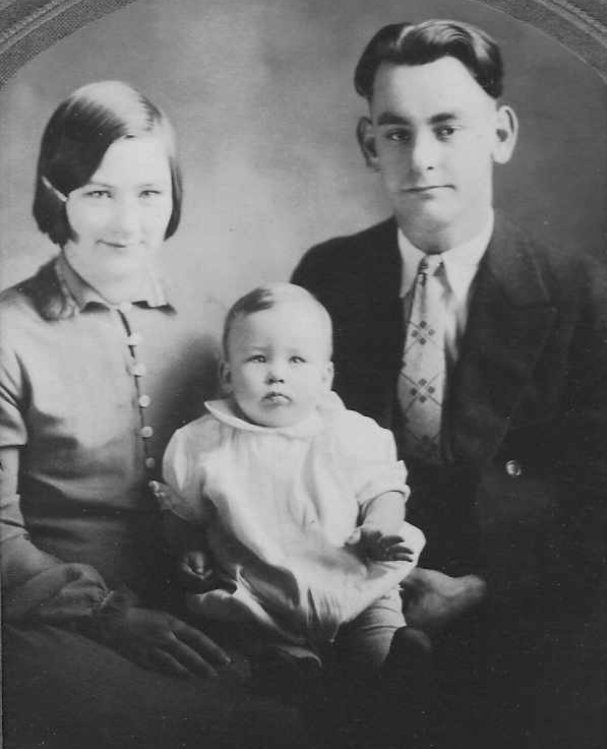
Katie and Mike have one son, Ron. Again, this seems like a different road in the same country for me. My great-grandparents had one son and no more and there was a story there. So maybe I’m seeing flags where none exist, but a single child in the 1920’s is interesting.
Katie and Mike are 16 when they get married. I don’t have a marriage record for them. Ron was born shortly after Katie had just turned 17. Katie’s mother has a child two years earlier, in 1925, when she is 43. I began to wonder, what if Mike Sutherland or Katie Mills cannot have children? What if Ron is Katie’s brother? What if I’m seeing an intra-family adoption?
That could explain why no other mystery family is filling in for the missing Sutherlands and the larger-than-expected DNA matches that make my wife seem older than she is. It would also explain the Swedish Y DNA since if Ron is Katie’s brother, the male line is from Sweden.
There are other, more unseemly explanations, and some close genetic relatives are unknown except that they are related to the Mills/Svensons. There are a lot of possibilities, but I can’t think of a way to sort them out and negate any, except for one path I’ve been down before.
Back to Ancestry and FTDNA
It was time to check the Mills family Y DNA to see if it matched my wife’s brother. DNA testing is more and more difficult as time goes on and as fear about how that information is handled is growing (along with many other fears). I figured my best success would be to find a Mills male relative who had already done DNA testing. So I went to Ancestry.com and used Thrulines to look at my wife’s genetic matches in the Mills family. I found one male distant cousin related to her Third great-grandparents. A 3rd cousin 1x removed. The Y DNA triangulation would be to Johan Mills/Svenson Sr., who was from Goteborg, Sweden. Katie’s grandfather.
As luck would have it, my contact was willing to give a sample for Family Tree DNA. Since my wife’s brother had no Y111 matches, I went for that level of Y test. I figured I could bump up to Big Y later. A Y111 test would be useful for the contact if I were wrong and useful to me if I was right.
Surprisingly, I got a notification that his results were in, but there was no match at any level, so I asked him to log in and send a screenshot of his Y results to see his Y STR values.
I could see that they matched when I compared their values in a homemade spreadsheet.
Then, through whatever magic, maybe spurred by his login, the Y111 match appeared in my wife’s brother’s results. A big Y test would be the completionist route, but a Y111 for someone who doesn’t have any Y111 matches, is pretty good. I’m 99% confident that Ron Sutherland is actually Ron Mills…is actually Ron Svenson.
To What End?
I could say it doesn’t matter, but it obviously matters to me.
At every step, I checked with my wife. She had no burning need to figure this out, but she was supportive of my efforts. Her brother only gave DNA because we asked him to. He has never really asked a question about it.
The only people I think would be interested are those other close genetic relatives who have an adoption somewhere in their family. It might help them know why the matches are so close and help them figure out which generations to look at.
I’m posting this here as a reference point for someone who may care. There may be people working on important and life-altering problems who get a spark from this somehow.
For me, this is fly fishing.